1941 Wheat Penny Without a Mint Mark: Empty Space Under the Date
For a person starting to collect US coins, understanding mint marks becomes one of the first important discoveries because these tiny letters, like D for Denver or S for San Francisco, serve as a passport for the coin. However, seeing millions of coins including the famous 1941 Wheat Penny No Mint Mark under the date at all, many people feel confused.
Contrary to a popular myth among non-professional people, the absence of a mark on the 1941 coin not being a minting error or a rare defect making the coin worth a million dollars actually represents the work of the oldest and main factory of the US Mint.
Philadelphia Mint
To understand the reason for the 1941 penny having no letter, looking into the history and traditions of American minting is necessary because the Mint in Philadelphia was founded in 1792 and remained the only factory of this kind in the country for a long time.
The Tradition of Having No Mark
Following a rule for almost two centuries with very few exceptions, the Philadelphia Mint decided that its products did not need a special mark being the main office. Believing that a coin came from Philadelphia by default unless seeing another mark, people accepted this tradition.
In 1941, workers followed this rule very strictly; therefore, the absence of a mint mark on the 1941 Wheat Penny means only one thing: this coin was made in Philadelphia.
The Scale of Production in 1941
The year 1941 was a record time because the US economy began to recover from the Great Depression with industry moving to military needs and the demand for cash increasing quickly.
Minting an incredible number of Lincoln cents reaching 887,018,000 pieces in Philadelphia, the factory worked very hard. Being one of the most common coins in the Wheat Penny series produced from 1909 to 1958, the 1941 penny without a mark stays easy to find because of this huge number.
Technical Details and Design
The 1941 Wheat Penny represents the classic design of Victor David Brenner introduced in 1909 to celebrate the 100th birthday of Abraham Lincoln.
Obverse
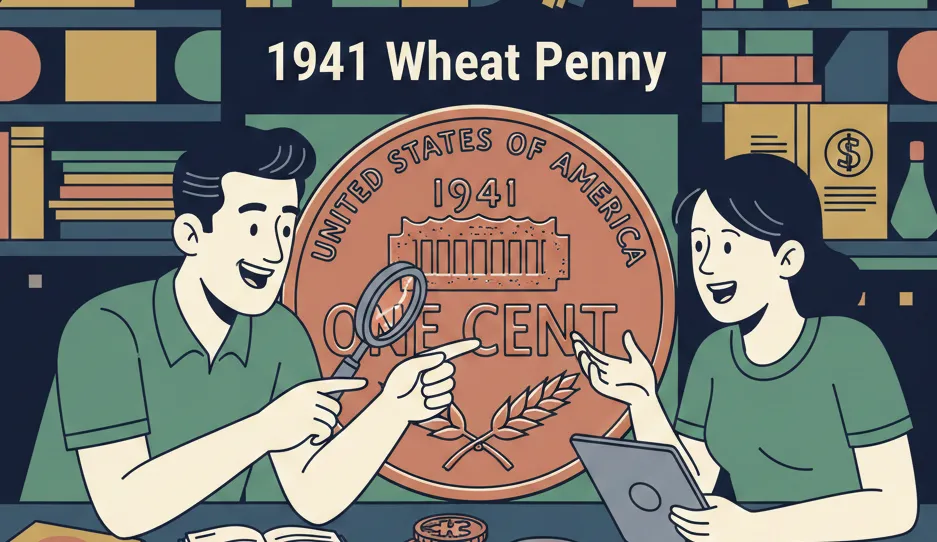
Showing the profile of the 16th US President Abraham Lincoln, the obverse side has the words "IN GOD WE TRUST" above his head. Having the word "LIBERTY" on the left and the date "1941" on the right, the coin looks very traditional. Looking at the space under the numbers of 1941, collectors search for a mint mark and, finding nothing there, they know it is a Philadelphia coin.
Reverse
The reverse side features two ears of wheat giving the coin its name "Wheat Penny" and surrounding the words "ONE CENT" and "UNITED STATES OF AMERICA". Having the Latin words "E PLURIBUS UNUM" at the top, the design looks very balanced and simple.
Metal Content
In 1941, the Mint made coins using a classic mix of metals:
95% copper
5% tin and zinc
This is very important because, replacing copper with steel coated in zinc in 1943 due to World War II needs, the government changed the coins, making the 1941 copper pennies the last ones following the old pre-war standard.
The Historical Context of 1941
The 1941 coin works like a time capsule being the last full year the USA spent in peace before the attack on Pearl Harbor in December 1941.
Coming out of the Philadelphia machines:
The coins appeared while America was not yet officially in World War II.
People used these cents buying newspapers with headlines about battles in Europe.
The huge production happened because of the need to provide small coins for the growing economy and military orders.
For a collector, the lack of a mark on the 1941 coin symbolizes the power of American industry working at its limit before the global conflict.
Value and Rarity
Because the Philadelphia production reached almost 900 million, a coin in a normal used condition costs only a little more than its face value.
Circulated Coins
Having signs of wear and tear, these coins usually cost from 10 to 50 cents. Being historical objects rather than financial investments, they are still interesting for many people.

Uncirculated Coins (MS)
Keeping their original "red" (RD) shine and never being used in shops, some coins have a very high value and can be checked with the best free coin identifier app.
MS-63 or MS-64: Costing from 5 to 20 dollars, these are nice for new collectors.
MS-66 RD: The price goes up to 50–100 dollars.
MS-67 RD: Appearing at big auctions, these coins can cost 500 dollars or more.
MS-68 RD: Being the rarest condition for 1941, such a coin can reach a price of several thousand dollars.
Proof Coins
Producing 21,100 "Proof" coins for collectors in 1941, Philadelphia made very special pieces with a mirror-like surface. Having no mint mark but showing great detail, these coins cost from 50 to 500 dollars depending on how they look.
Minting Errors — Where Is the Real Value?
Although the absence of a mint mark is not rare itself, finding real numismatic treasures among the 1941 Philadelphia coins is possible when looking for technical mistakes.
Double Die Obverse (DDO): Making a mistake during the creation of the stamp, workers produced a double image. Seeing doubling in the date or the word "LIBERTY", collectors pay a lot of money.
Lamination Errors: Having the metal peeling off because of dirt in the copper mix, some coins look very unusual.
Die Cracks: Showing thin raised lines on the surface, these coins appeared because the stamp broke during work.
Off-Center Strike: Moving the metal piece during the process, the machine created an image not in the center.
Red, Red-Brown, Brown
For US copper coins without a mark from 1941, the color of the surface is very important for the price and for coin finder determination:
Red (RD): Keeping 95% or more of the original orange-red shine, these are the most expensive ones.
Red-Brown (RB): Mixing the original shine with some brown oxidation, these coins have a middle price.
Brown (BN): Being completely brown, most coins from people's pockets look like this.
How to Tell the Difference Between Mints?
Seeing the letter "D" under the date, you know it is from Denver, but seeing the letter "S", you know it came from San Francisco.
Producing 7 times more coins than Denver and 9 times more than San Francisco, Philadelphia explains why "coins with no letter" appear in our hands most often.
Why Is 1941 Important?
Having no mint mark on the 1941 Wheat Penny is not a reason for sadness because of the coin's ordinariness but a reason to appreciate the stability of the American money system of that time.
Holding a dirty brown 1941 cent or a shiny red MS-67 piece, you hold a part of history. Seeing the start of World War II and hearing the jazz of the 40s, this coin passed through millions of hands before reaching you.
For a collector, the absence of a mark on this coin remains a proud sign of Philadelphia, the "mother" of all American coins, providing the country with a record amount of cash during the difficult year of 1941 and helping the economy of a great power move forward.